
By Unice · Operator, Aberdeen House III Assisted Living · Rockville (Montgomery County), MD · Published September 2026
As an Amazon Associate I earn from qualifying purchases. This post has one Amazon affiliate link; if you buy through it, I may earn a small commission at no extra cost to you.
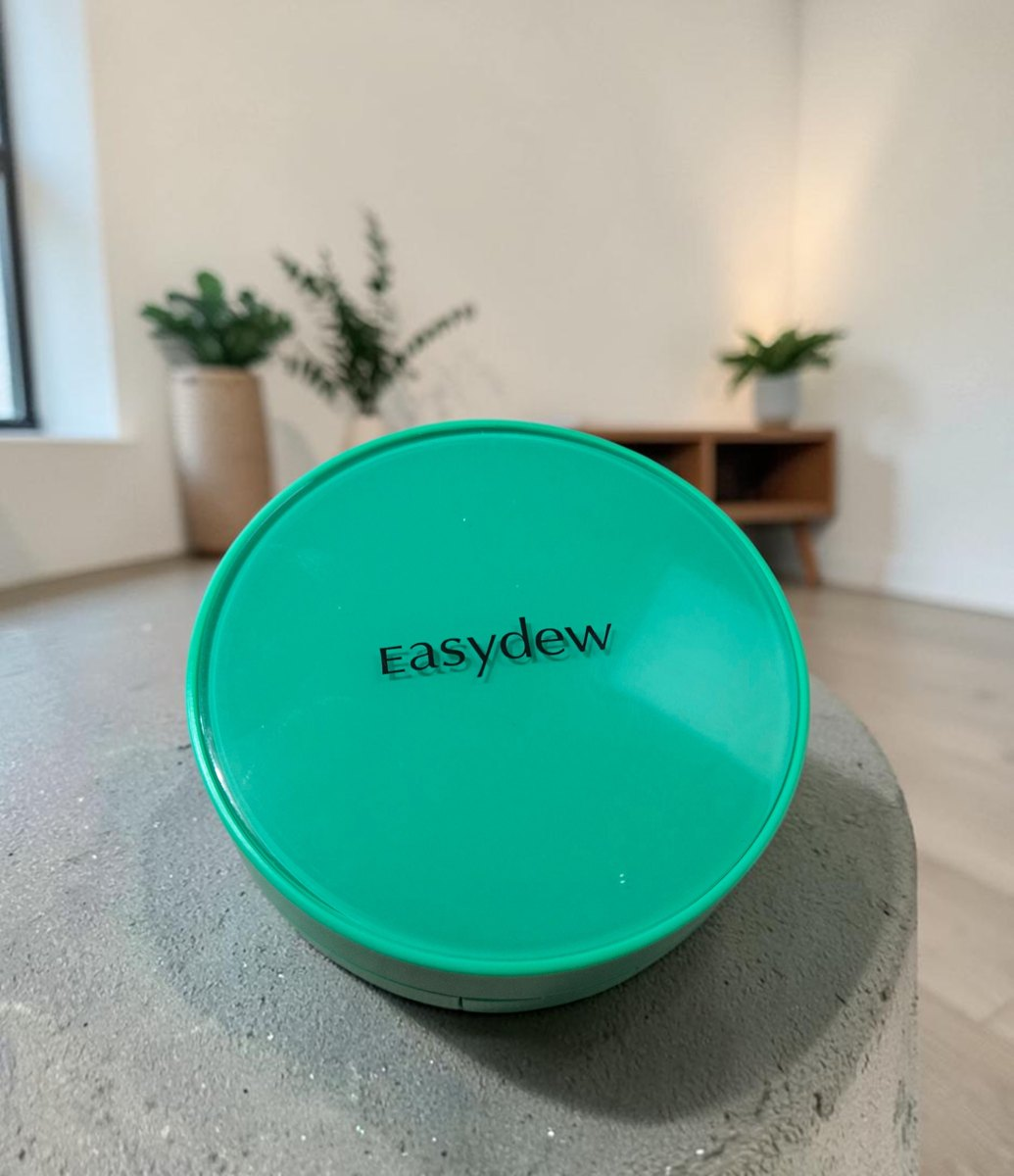
On mature skin, a cushion foundation tapped on in thin layers, with a second tap only over the spots, covers age spots and melasma more naturally than one thick coat of foundation. I’m on my third Easydew Mela B Toning Ampoule Cushion (#21 Beige): thin, high coverage, no cakiness. The US version comes in 10 shades.
You add one more layer of foundation, and the spots still peek through. Meanwhile, the makeup has already settled into the lines around your eyes. Plenty of us hit this wall in our 50s: the harder you try to cover, the older you look. Rude, but true.
I’m in my 50s too. This year I picked up the Easydew Mela B Toning Cushion in #21 Beige here in the US, and it was different. It went on thin but covered beautifully, matched my skin, and never lifted or caked. My skin felt moist afterward, like I’d just put on an essence. I used it up, bought another, and I’m now on my third.
Along the way, I noticed something I didn’t expect: my spots seemed to be getting a little lighter. Funny enough, that’s nearly word for word what the brand’s Korean TV ad says. In the spot starring actress Han Ga-in, the line is “가리려고 발랐는데 기미가 흐려지네,” which translates to “I put it on to cover my spots, and they’re fading.”
So let me draw a clear line right here. That sentence is ad copy, and my impression comes from exactly one face: mine. Below, you’ll find what the ad claims versus what’s actually in the compact, how to pick your shade, how to apply it over 50 without the cake, and what a cushion simply can’t do.
- Covering spots over 50 isn’t about one thick coat. It’s thin all over, plus one more layer only where you need it.
- Easydew is the dermocosmetic brand of Daewoong Pharmaceutical. This cushion launched in Korea on September 30, 2024 and reached the US later.
- The US version is 12.8 g (0.45 oz) in 10 shades (#13 Porcelain to #45 Espresso) and lists no SPF. Mine is the US #21 Beige.
- How it wears on me (bought this year): thin, good coverage, no lifting, moist like an essence.
- “They’re fading” is the Korean tagline from the Han Ga-in campaign that started December 20, 2024. The lightening I noticed is just my personal impression.
- A cushion is makeup, not medicine (and not sunscreen). Have any spot that changes shape or color checked by a dermatologist first.
- Why does foundation look cakey on mature skin?
- What is a cushion foundation, and why does it suit mature skin?
- What’s in the Easydew Mela B Toning Cushion?
- What shades does the US version come in? All 10 shades
- My honest experience: coverage, color, and how it feels
- How to apply a cushion on mature skin to cover age spots
- What people get wrong about covering melasma with a cushion
- Watch out: what a cushion can’t do for dark spots
- Checklist before you buy and apply
- Do it here: the links you need
- FAQ
Why does foundation look cakey on mature skin?
Skin in its 50s is drier and has more fine lines than it used to, so a thick layer of foundation settles into lines and pores and makes them stand out. Every extra coat you add to hide spots makes it worse. The fix is less product, built up in thin layers only where you need it.
Younger skin forgave a generous pump of foundation. Skin over 50 holds a grudge. Put a heavy layer on skin that’s short on moisture, and within a few hours it cracks, and every smile leaves a crease behind.
Then the spots show through, so you add more, so it cakes more. To break that loop, change how you apply before you change what you buy. And the tool built for that method is a cushion.
What is a cushion foundation, and why does it suit mature skin?
A cushion foundation is a Korean-style base: a sponge soaked in liquid foundation, sitting inside a compact, that you pick up with a puff and tap onto your skin. Each tap deposits only a little, so you start thin and add a second layer just over the spots, which means far less cakiness on mature skin.
Open the compact and you’ll find a soft, damp sponge with a puff on top. Press the puff lightly into the sponge, then tap it onto your face instead of rubbing. Pat, don’t paint. Rubbing pushes product down into the lines; tapping leaves a thin film on the surface.

That last row matters: load up the puff, and a cushion gets heavy too. Its real advantage is that it makes “thin, then a little more” easy, and the how-to section below walks through it step by step.
Concealer is actually part of why this particular cushion exists. When Daewoong Pharmaceutical launched the Han Ga-in campaign, the company said it made the cushion “to solve the problem of spots not covering in one go, so shoppers needed an extra concealer” (Newsis, Dec. 22, 2024, translated).
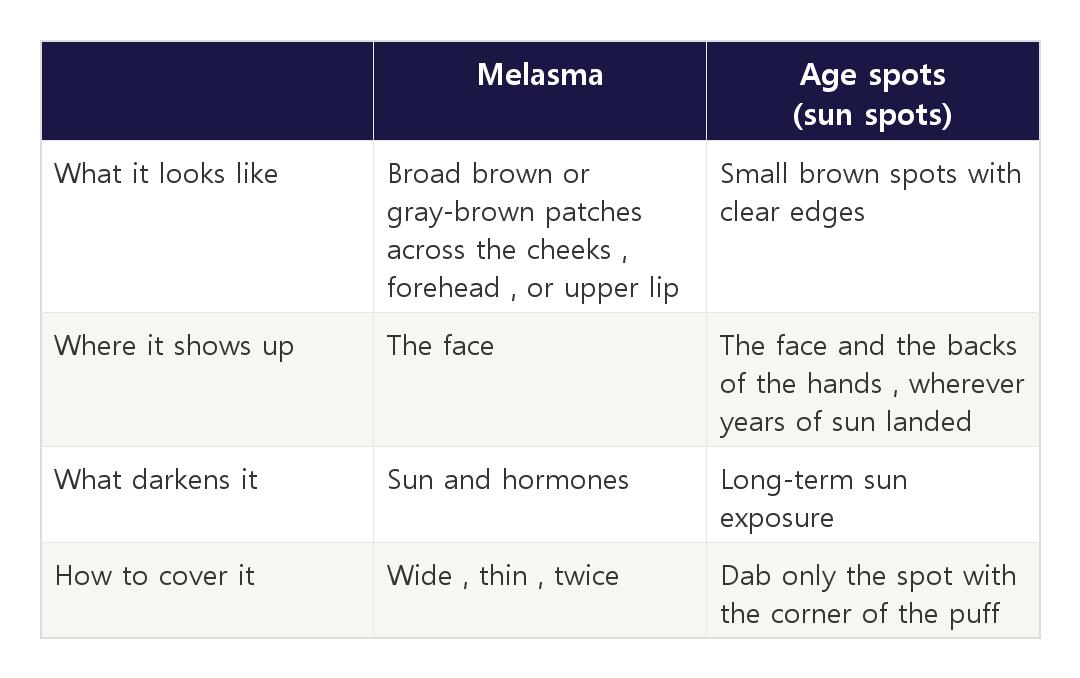
How are melasma and age spots different?
They look different, so you cover them differently.
What’s in the Easydew Mela B Toning Cushion?
Easydew is the dermocosmetic line of Daewoong Pharmaceutical, a Korean drugmaker, and the brand names three key ingredients in this cushion: DW-EGF, which Daewoong developed; niacinamide, a tone-care staple in skincare; and a hyaluronic acid and vitamin C blend. In the US, the brand sells it as a “2-in-1 skincare and makeup cushion.”
The full name is Easydew Mela B Toning Ampoule Cushion. Easydew’s official Korean store sells it simply as the “melasma ampoule cushion,” and in Korea it goes by a nickname: “Han Ga-in’s melasma cushion.” Makeup from a drug company? That alone gets people curious.
Easydew’s US store says the cushion “brightens dull skin,” “softens fine lines,” and goes from “sheer to full coverage.” Glutathione also shows up in the brand’s description.
Here’s what the brand says, side by side with how I read it.
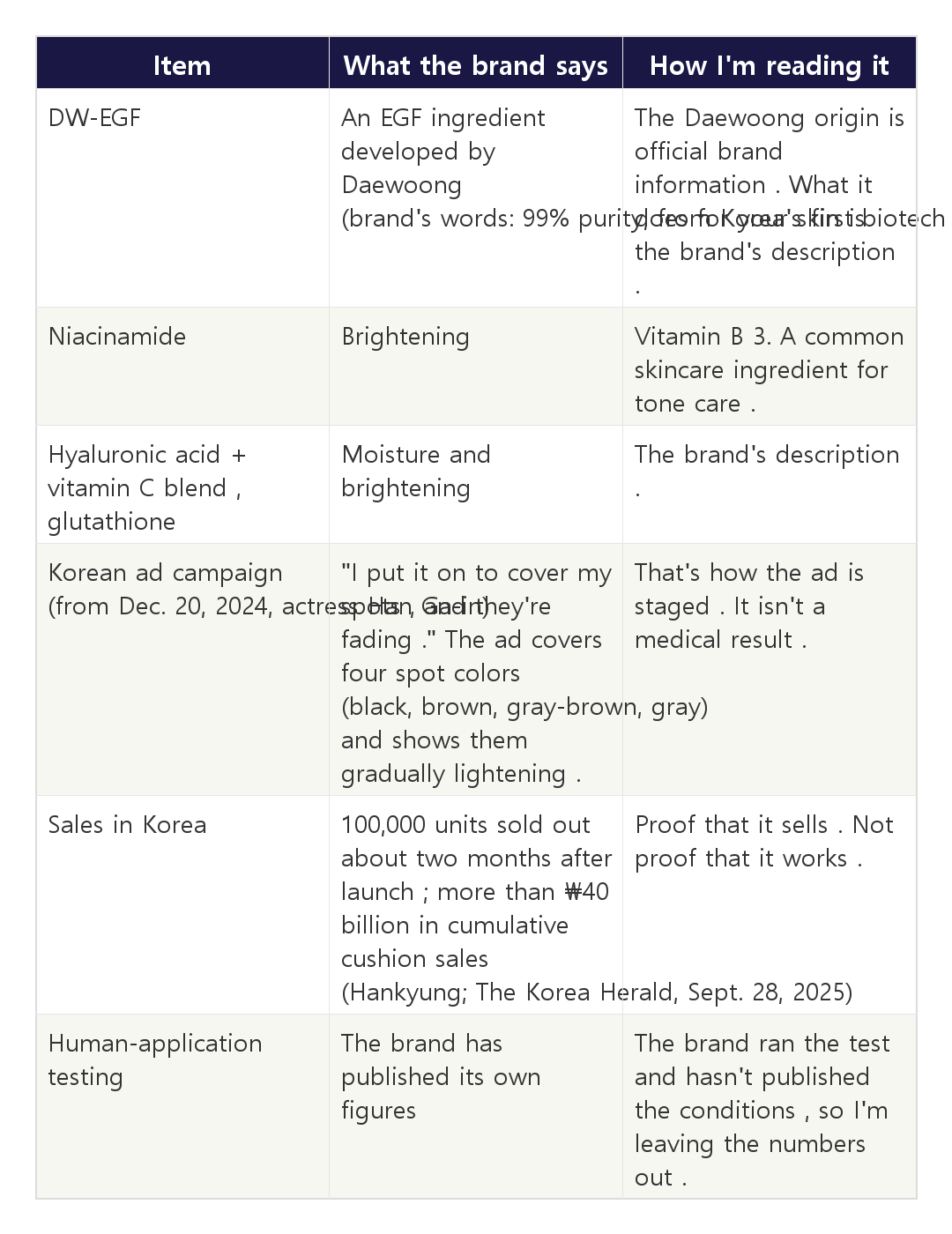
That last row is a deliberate omission. Numbers make a post look convincing, but I won’t hand you a figure to base a skin decision on when I don’t know how it was measured, or on whom.
What shades does the US version come in? All 10 shades
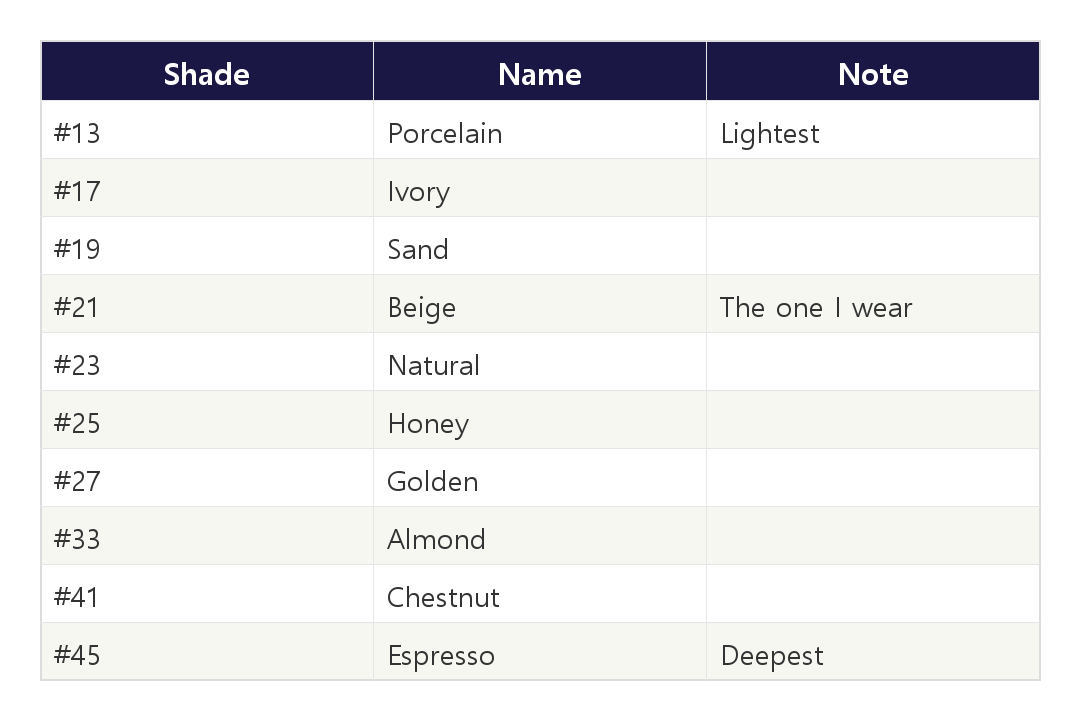
The US Easydew Mela B Toning Cushion comes in 10 shades, from #13 Porcelain to #45 Espresso, in a 12.8 g (0.45 oz) compact. The higher the number, the deeper the shade, so the range runs from very fair to deep skin tones. I wear #21 Beige. The US version lists no SPF.
- Refills are sold separately, so when a compact runs out, you just swap the insert.
- The shade range is the first strength I’d point to. With a spread this wide, nearly every skin tone should find a match.
How to pick your shade
- Match your neck and jawline. Choose by your face alone and you’ll get a tidy line right where your face ends and your neck begins.
- Don’t go lighter than your face. A too-light shade over brown spots turns them grayish.
- Compare on the US official swatches first. The link is in the “Do it here” section below.
My honest experience: coverage, color, and how it feels
I bought my first Easydew Mela B Toning Cushion in #21 Beige this year and I’m already on my third. It goes on thin but covers remarkably well, matches my skin, and doesn’t lift or cake. It feels moist, almost like an essence. Over time my spots seemed lighter, but that’s my personal impression.
The short version: this one was different. And the best review I can give isn’t anything I say. It’s that I keep buying it. For women in their 50s like me, it’s a genuinely good cushion.
It goes on thin, but it really covers
This is the big one. On skin over 50, “thin” and “covers” rarely show up in the same product. Usually, covering means going thick, and going thin means the spots peek through. Here, one thin layer covered my spots, so there was nothing to pile on. And the less you put on, the less settles into your lines.
The color matched
#21 Beige matched my skin really well. When you choose a cushion, look at color before coverage. If the shade is off, it doesn’t matter how well it hides spots. Your face just ends up looking like it belongs to someone else.
No lifting, and moist like an essence
Nothing lifted or flaked, and my skin felt moist afterward, the way it does right after an essence. The name says “ampoule” and the brand pitches it as skincare plus makeup, and that’s exactly how it felt going on. If dryness is what cracks your makeup by lunchtime, you’ll notice.
What other reviewers say
One Korean user wrote that “one tap evens tone cleanly; a second layer covers darker spots without caking” (Unpa review, Dec. 30, 2025, translated). On the other hand, a reporter who tried it right after launch said it didn’t perfectly cover other blemishes (Asia Business Daily, Dec. 13, 2024). The fair read: it’s strong on spots and melasma, but it’s not a one-pass eraser for every blemish.
About the “spots looking lighter” part
I’ll say this one carefully. As I kept using it, my spots seemed to get a little lighter, which points the same way as the brand’s Korean ad line.
The brand says it added tone-care ingredients like niacinamide. Whether that’s what I noticed, or something else entirely, I can’t say for sure. What I can say with confidence is “it covers well.” The “lighter” part is one woman’s impression of her own face.
How to apply a cushion on mature skin to cover age spots
To apply a cushion on mature skin: (1) moisturize well first, (2) pick up only a little product on the puff, (3) tap, don’t rub, into a thin layer, (4) add one more layer only over spots and melasma, and (5) finish lightly. The point is building coverage where you need it, not blanketing your whole face.
Step 1. Moisturize first, then sunscreen
Apply your cream or serum and give it a minute to sink in. A cushion on dry skin cracks along every texture line. Sunscreen goes on at this stage too, so the order is moisturizer → sunscreen → cushion.
Step 2. Just a little on the puff
Press the puff into the sponge lightly, once or twice. Press hard and the amount jumps. New to cushions? Tap once on the back of your hand first, then go to your face.
Step 3. Tap from the center of your face outward
Start in the middle of your cheek and tap your way out. No rubbing. Around the eyes and mouth, where the lines live, whatever is left on the puff is plenty.
Step 4. One more layer, only on the spots
Once the first layer has settled for a moment, tap again only where you want more coverage.
- Broad melasma patches: use the flat side of the puff and do two thin passes.
- Small age spots: fold the puff in half and dab just that spot with the corner.
Step 5. Finish light
If you use powder, use a tiny bit and only where you get shiny. A heavy all-over dusting makes lines stand out on dry skin. For touch-ups during the day, just tap the cushion over the spots again.
What people get wrong about covering melasma with a cushion
Three myths come up most: that cushions are too light to cover melasma, that a cushion with SPF means you can skip sunscreen, and that a “melasma cushion” treats melasma. All three are wrong. A second layer handles coverage, a thin cushion layer won’t give you the SPF on the label, and a cosmetic is not a treatment.
Myth 1: “Cushions are too light to cover melasma”
A cushion is made to be layered: one pass is thin, and a second over the spots raises the coverage. Easydew’s Korean ad shows it covering four spot colors (black, brown, gray-brown, and gray). A Korean user review says darker spots cover “without caking” with one more layer. And on my own face, one thin layer covered my spots well.
Myth 2: “My cushion has SPF, so I can skip sunscreen”
You still need sunscreen on its own. For starters, the US Easydew cushion lists no SPF at all, and that’s the version you’ll get on Amazon or from the US official store.
Even an SPF50+ PA+++ label, like the Korean version’s, doesn’t change the answer. SPF is measured in a lab with a set, generous amount of product, and a puff lays down far less than that. In the US, any product that claims SPF is regulated as an over-the-counter drug (FDA). The brand hasn’t said why the US version skips SPF, but the bottom line is the same: sun darkens melasma, so sunscreen goes on before your cushion.
Myth 3: “A melasma cushion makes melasma go away”
Under FDA rules, once a cosmetic claims to treat a disease or change the body’s structure or function, it becomes a drug. This cushion is a cosmetic, and the US store sticks to cosmetic words like “brightens,” “softens,” and “coverage.” The brand’s test figures come without published conditions, “they’re fading” is ad copy, and my “seemed lighter” is one person’s impression. Treating melasma is a dermatologist’s job.
⚠️ Watch out: what a cushion can’t do for dark spots
A cushion is a cosmetic that covers dark spots, not a treatment. Any new dark spot, or any spot changing in shape, color, or size, should see a dermatologist before it sees your cushion. And patch-test any new product first.
- Show a changing spot to a doctor before you cover it. Some spots that look like ordinary age spots need a closer look. If a spot is getting bigger, has several colors mixed together, has a ragged border, or is a new dark spot, the dermatologist comes before the cushion. You can find one near you by ZIP code on the American Academy of Dermatology’s search page (link below).
- Sunscreen every day, as its own step. Cloudy days included. Reapply on long days outdoors, and a wide-brimmed hat helps with melasma too.
- Patch-test first. Try it on your inner arm or under your jaw for a few days, and go full-face only if there’s no redness or itching. Reviews disagree on whether it contains fragrance, and I couldn’t confirm either way, so if you’re fragrance-sensitive, read the full ingredient list on the box first.
- If you’re being treated for melasma, ask your doctor when to put makeup on while you’re using a prescription cream.
- Keep the puff clean. It touches your face every day, so treat it that way: wash it with a gentle cleanser, let it dry completely, and replace it when it wears out.
- Buying it for your mom? Match the shade to her neck and jawline (sneakily, if you have to), and suggest a patch test before she uses it all over.
Checklist before you buy and apply
- ☐ Pick your shade by your neck and jawline, and compare on the US official swatches
- ☐ Don’t trust the number from a Korean cushion (same number, different color name in the US)
- ☐ Patch-test on your inner arm or under your jaw
- ☐ Keep the order: moisturizer → sunscreen → cushion (the US version lists no SPF)
- ☐ A little product on the puff; tap, don’t rub
- ☐ One more layer only on spots and melasma
- ☐ Powder only where you get shiny, and only a little
- ☐ Any spot changing in shape or color goes to a dermatologist first
- ☐ Wash the puff, and swap in a refill when the compact runs out
Do it here: the links you need
Official and primary pages
- Easydew US official product page: see swatches for all 10 US shades and pick yours.
- AAD Find a Dermatologist (American Academy of Dermatology): enter your ZIP code to find a board-certified dermatologist nearby. If a spot is changing, start here.
- FDA: Is It a Cosmetic, a Drug, or Both?: the FDA’s own explanation of the line between cosmetics and drugs, including how sun-protection products are classified.
- Buy the US #21 Beige on Amazon: the button at the end of this post (affiliate link).
Background reading
- Easydew Korea official store product page: ingredients and shades for the Korean version (in Korean).
- Newsis on the Han Ga-in ad campaign (Dec. 22, 2024, in Korean).
FAQ
Is a cushion or liquid foundation better for skin over 50?
For covering spots naturally, a cushion is easier. Tapping with a puff lays down a thin layer and lets you add a second one only on the spots, so less settles into lines. Liquid can work if you tap it on thin, but a cushion makes the amount much easier to control.
Does the Easydew Mela B cushion get rid of melasma?
No. It’s a cosmetic that covers melasma. “They’re fading” is the brand’s Korean ad line, and while my spots did seem lighter to me, that’s a personal impression, not a treatment result. For melasma treatment, see a dermatologist.
Can I skip sunscreen if I wear the Easydew cushion?
No. The US Easydew cushion lists no SPF, and even an SPF-labeled cushion like the Korean version won’t deliver the label’s protection at the thin amount you tap on. Sunscreen first, then cushion.
How do I choose my Easydew cushion shade?
The US version comes in 10 shades, #13 Porcelain to #45 Espresso, and higher numbers are deeper. I wear #21 Beige. Match your neck and jawline, and don’t go lighter than your face. If you’ve used the Korean cushion, check the official swatches, because the same number carries a different name.
If you’d like to see the exact one I use, it’s on Amazon. The button below goes to the same US #21 Beige (0.45 oz). Need a different shade? Check the official swatches first.
As an Amazon Associate I earn from qualifying purchases.
Quick Recap: For spots over 50, a cushion tapped on in thin layers covers more naturally than one thick coat. The US Easydew Mela B Toning Cushion in #21 Beige goes on thin, covers well, matches my skin, and stays moist without lifting. It comes in 10 shades and lists no SPF. And any spot that’s changing goes to a dermatologist before it goes under makeup.
Sister Unice’s Final Takeaways
- The secret to coverage over 50 is the method more than the product: thin, then one more layer only where you need it.
- The Easydew Mela B Toning Cushion earned its spot in my routine: thin, great on spots, no lifting, moist like an essence. I’m on my third compact.
- The US version comes in 10 shades (#13 to #45), so most skin tones have a match. I wear #21 Beige.
- “They’re fading” is the brand’s Korean ad line; the lightening I noticed is my personal impression.
- One thing to do today: check your neck and jawline in the mirror, then find your shade on the official US swatches.
Sources
- The Bio News: Easydew melasma ampoule cushion launch (Sept. 30, 2024)
- Newsis: Easydew’s Han Ga-in campaign and why the cushion was made (Dec. 22, 2024)
- EMD: ad campaign and four-spot-color coverage (Dec. 20, 2024)
- Startup Today: Easydew ad campaign (Dec. 20, 2024)
- MD Today: Easydew Mela B coverage
- Hankyung: 100,000 units sold out within two months
- The Korea Herald: Easydew cushion cumulative sales (Sept. 28, 2025)
- Asia Business Daily: product review (Dec. 13, 2024)
- Unpa: user review (Dec. 30, 2025)
- Glowpick: Korean version product info (15 g, SPF50+ PA+++)
- Easydew Korea official store: melasma ampoule cushion (shades 19, 21, 22, 23)
- Easydew US official store: Mela B Toning Ampoule Cushion (12.8 g, 10 shades)
- Amazon: Easydew Mela B Toning Ampoule Cushion Foundation, 0.45 oz (#21 Beige)
- U.S. FDA: Is It a Cosmetic, a Drug, or Both? (Or Is It Soap?) (updated Sept. 11, 2024)
- U.S. FDA: Questions and answers on FDA’s regulatory actions for OTC sunscreen
- American Academy of Dermatology: Find a Dermatologist
About the author
Unice runs Aberdeen House III, a licensed assisted living home in Rockville (Montgomery County), Maryland. She grew up in Seoul, worked as a fashion designer in Manhattan’s Garment District, and has lived in the US since 2009. On this blog she writes about aging well after 50 and caring for parents, and only about what she has lived through or checked herself.
Leave a Reply