

I once toured our care home with a family who were certain their mother’s Medicaid waiver had already been approved.
What’s actually eating your family’s budget right now — the cost of care itself, or something else entirely? The answer changes which government program you should be chasing, and a lot of families spend months applying for the wrong one before they figure that out.
Why This Question Comes First
I run an assisted living home in Maryland, and I’ve seen the word ‘waiver’ cause real confusion. Families hear it somewhere and assume it’s the one program that solves everything. Depending on the situation, the right first step may be a different program, or more than one.
When I contacted the social worker at her rehab facility to coordinate admission, I discovered that only her Medicare had been approved and the waiver application had never even been submitted.
These programs sound similar but serve completely different purposes. Applying for the wrong one doesn’t just waste time — it can mean missing help you actually qualify for right now. So before this series gets into the details of the Medicaid Waiver itself, let’s answer the more basic question: is that even the right program for your situation?
What a Medicaid Waiver Actually Covers
A Medicaid Waiver (formally, an HCBS — Home and Community-Based Services — Waiver) is a separate program that pays for the cost of care itself — assisted living or in-home support — that regular Medicaid doesn’t cover. If the bill that’s stressing you out is the monthly rate at an assisted living community or a home care agency, this is the program built for that.
We’ll cover eligibility and the application process in detail later in this series. For now, remember one thing: Waiver = help paying for care. If your most urgent problem is medical bills, groceries, or general income, keep reading — a different program probably fits better.


When Something Else Fits Better
Match your family’s most pressing issue to the row below.
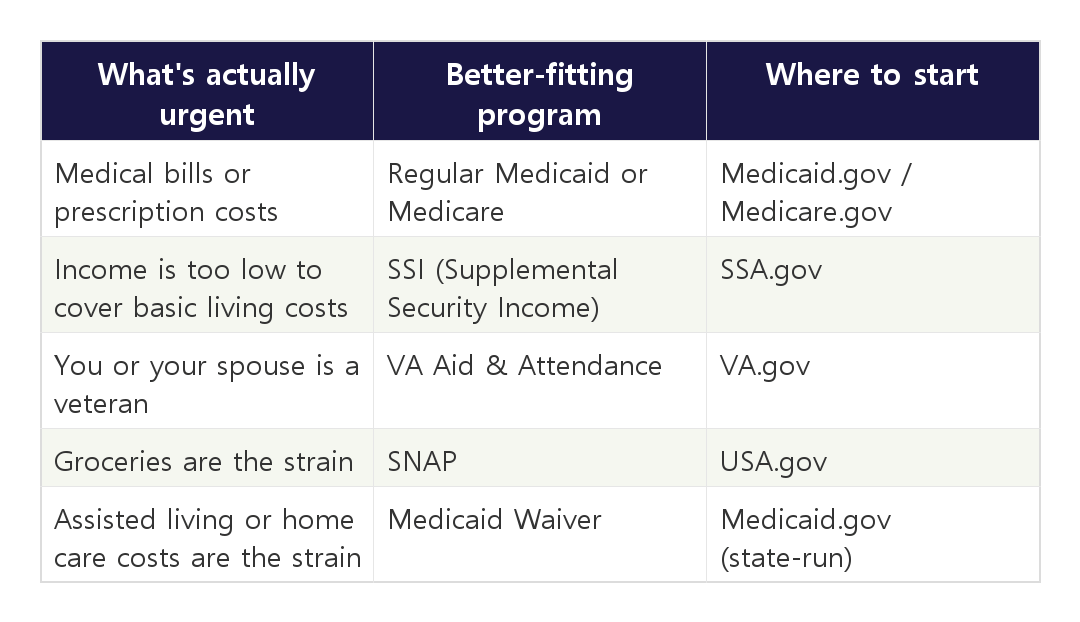
In practice, it’s rarely just one box. Many families end up applying for more than one program at the same time — a resident already on Medicaid Waiver applying for SSI alongside it is a common combination. Don’t stop after filing just one application.
What To Check Before You Apply Anywhere
- What’s the actual monthly cost that’s causing stress — care, medical, income, or food? (It’s fine if it’s more than one.)
- Is anyone in the family a veteran?
- Is your relative currently in — or seriously considering — assisted living or a nursing home? That’s a strong signal a Waiver applies.
- Are they already enrolled in regular Medicaid? (Most Waivers require that as a baseline.)
Answer those four honestly, and the rest of this series — starting with the next post on how Medicaid and Medicare actually differ — will be much easier to follow.
FAQ
Q. I keep mixing up Medicaid and Medicare. Are they the same thing?
A. No — they’re entirely different programs. We’ll break down the difference clearly in the next post in this series.
Q. Can I apply for more than one program at once?
A. Yes, and it’s usually the right move. Each program serves a different purpose, so there’s typically no conflict — just check the income/asset rules for each one individually.
Q. I genuinely don’t know where to start.
A. Pick whichever row in the table above matches your most urgent cost, and start with that program’s agency. A case manager at an assisted living community can also usually point you in the right direction.
At Aberdeen House III, we offer guidance on this process, Medicaid Waivers included, so families know which steps to take next. Reach out any time if you’d like a hand.