

I have met many families during tours of my home in Maryland, and I noticed that they usually focus on the cost of care. If I were the family, I’d ask more about the daily routine and the food, because that is what a resident’s life is actually made of.
When a terrified voice on the phone sounds exactly like your grandchild begging for emergency bail money, your first instinct is to help — no questions asked. That instinct is exactly what scammers are counting on. AI voice cloning scams now cost elderly Americans an estimated $2.3 billion in 2026, with cases up 340% year-over-year, and adults over 60 account for roughly 43% of all AI-fraud losses. Learning how to spot and protect against an AI voice cloning scam is quickly becoming as basic a family safety habit as locking the front door — and it only takes about ten minutes to set up.
By creating a simple family code word and learning to hang up and call back directly, you can instantly neutralize these scary traps. Trust me on this one—a small conversation with your parents today will prevent heartbreak tomorrow.
(Please note: While I share safety tips from my work with seniors, this post is for general educational purposes. Always consult with your healthcare provider or mental health professional if a scary call causes severe distress or anxiety.)
- How does the grandparent scam 2026 actually operate?
- What is the family safe word scam protection strategy?
- Why should you always hang up and call back on a saved number?
- How do real emergencies compare to AI clone scam calls?
- How can you calm an anxious parent who got a scary call?
- What phone settings can you adjust today for safety?
- FAQ
- Helpful links — Sister Unice’s picks
- Sources
How does the grandparent scam 2026 actually operate?
Scammers pull short video clips from public Instagram reels, Facebook posts, or TikToks to sample a loved one’s voice. Advanced software then analyzes the pitch, tone, and accent to build an artificial voice model in less than a minute.
Do you know how easy it is for strangers to find three seconds of video online?
That short clip from last summer’s backyard barbecue is all a scammer needs to sound like your child.
The caller then phones an older relative using this cloned voice, crying that they were arrested, in a car accident, or mugged on vacation. They demand immediate wire transfers, digital gift cards, or cryptocurrency while begging you not to tell anyone.
What is the family safe word scam protection strategy?
A family safe word is a secret code word or short phrase that only your immediate family members know. If anyone calls claiming to be in trouble, they must recite this exact word to prove their identity.
Choose something memorable yet completely random that is never posted online—like “Yellow Teacup” or “Pineapple 77”.
If the person on the line makes an excuse or hesitates when asked for the safe word, you know instantly that you are talking to an AI clone.
Insider tip: Write this safe word on a small sticky note and tape it directly to the back of your parent’s cell phone or next to their landline handset so they never forget it during a panic moment.

Why should you always hang up and call back on a saved number?
Caller ID numbers can be easily spoofed to display your child’s real name or city on the phone screen. Hanging up immediately breaks the emotional spell and allows you to confirm the truth.
When panic strikes, our logical mind turns off—which is exactly what scammers count on during these targeted calls.
Simply end the call, take a deep breath, and dial your relative using the number saved in your contact list.
Even if the caller screams, “Don’t hang up or I’ll go to jail!”, remember that real emergency services will always allow you to end a call and call back through official channels.
How do real emergencies compare to AI clone scam calls?
It helps to know what red flags separate a genuine family emergency from a high-tech hoax.
I have rushed to the house in the middle of the night many times because a fire alarm malfunctioned or a resident was wandering. These real emergencies require a physical presence and a calm response, which is very different from the scripted urgency of a voice on a phone.
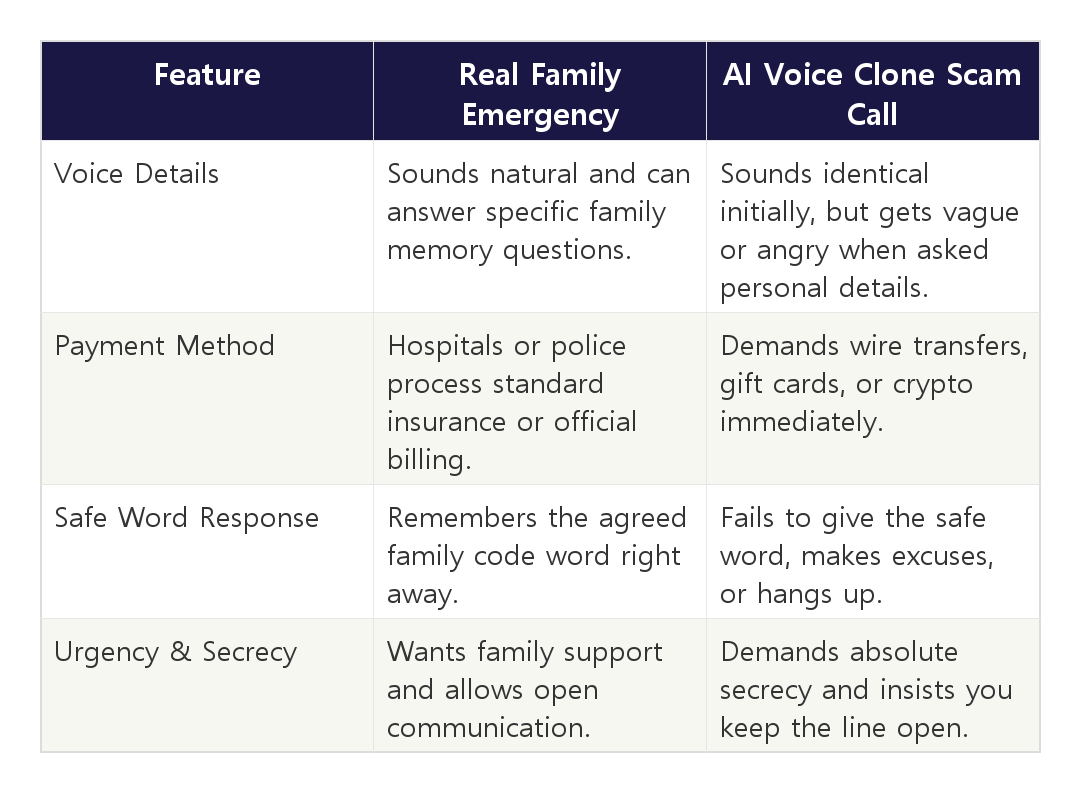
How can you calm an anxious parent who got a scary call?
Validate their feelings first, get them a warm drink, and help them verify that their loved one is safe using a second phone line.
I’ve been called over at night because a resident couldn’t sleep and kept walking around. That’s sundowning, and it’s part of dementia care. For someone who feels confused or scared, a calm, familiar presence often helps more than any words.
Hearing a grandchild’s voice screaming for help triggers genuine physical shock, even after you realize it was a fake call.
Sit right next to them, hold their hand, and say: “You did the right thing by checking, and everyone is completely safe.”
Insider tip: Do not leave an elderly parent alone in their room right after a scam attempt; sit with them in the kitchen for 20 minutes so their heart rate and blood pressure can settle back to normal.

What phone settings can you adjust today for safety?
You can turn on built-in smartphone features that automatically silence unverified numbers and filter out potential spam calls.
On iPhones, go to Settings, tap Phone, and turn on “Silence Unknown Callers” so unsaved numbers go straight to voicemail.
On Android phones, open the Phone app, tap the three dots, go to Settings, and enable “Caller ID & Spam Protection”.
Insider tip: If your parent relies on a physical home landline, buy an inexpensive plug-in call-blocking box that connects between the wall jack and phone base to filter unknown numbers automatically.
FAQ
Q. Can AI really copy someone’s voice from just a 3-second video?
A. Yes, modern AI tools only require a very short audio clip from social media to match someone’s vocal pitch and speaking rhythm.
Q. What if the caller says my relative is in custody and cannot talk long?
A. Always hang up immediately and call the official phone number of the police department or jail directly to verify.
Q. Where is the best place to keep our family safe word?
A. Keep it written on a small note near the home phone or saved under a quiet nickname inside your smartphone contacts.
Q. Should we report an attempted voice-cloning call if we didn’t lose money?
A. Yes, reporting failed scam attempts helps consumer protection agencies track fraud trends and protect other families in your area.
- Establish a secret, random family safe word with every elderly relative today — write it down somewhere they’ll actually remember it.
- Never trust caller ID alone. Hang up and call your relative back on their verified, saved phone number before you do anything else.
- Turn on unknown-caller silencing and spam filtering on smartphones and landlines — it’s free and takes two minutes.
Helpful links — Sister Unice’s picks
The best places to go deeper, hand-picked:
- FTC ReportFraud Portal — Official federal reporting hub used by law enforcement to track and dismantle AI impersonation and voice-cloning fraud rings.
- AARP Fraud Watch Network Helpline — Free, top-rated support helpline (877-908-3360) handling over 400 calls daily with trained fraud specialists to guide families.
- FBI Internet Crime Complaint Center (IC3) — Official FBI intake portal for logging cyber-enabled imposter scams, wire fraud, and high-tech family emergency calls.
- FTC Pass It On Fraud Prevention Kit — Widely commended official educational toolkit specifically created to help older adults and relatives talk through impersonation tactics.
These are official government and nonprofit resources, not paid placements.
Unice recommends filing a quick report here immediately after any suspicious call to help federal investigators track AI clone operations and protect other families.
This is a free federal resource — no affiliate link, no commission.
Sources
Federal Trade Commission (FTC)
FBI Internet Crime Complaint Center (IC3)
Federal Communications Commission (FCC)