

When someone living with dementia asks you the exact same question ten times in an hour, your patience can wear down to a frayed thread. The real secret to handling repetitive questioning is realizing that your loved one isn’t asking for facts—they are asking for reassurance. Meeting the hidden emotional need rather than debating the details is what finally breaks the loop.
A quick note before we start: I share these observations from daily life running an assisted living home in Maryland, but this is practical caregiving support, not medical advice. Always talk with your loved one’s doctor about sudden behavioral shifts.
The short-term memory loop behind repeated questions
To an outside observer, repeating the same sentence seems intentional or stubborn. In reality, damage to the brain’s hippocampus means the memory of having just asked simply vanishes within seconds.
To your loved one, each time they ask is genuinely the very first time. If they ask, “Where is my purse?” at 2:01, 2:04, and 2:08, their brain has completely wiped the previous two interactions.
Understanding this makes it a little easier to take a breath. They are not testing your limits; their brain is simply trying to anchor itself in an unfamiliar world.
Why does reminding them never work?
Our natural human instinct is to appeal to logic. We say things like, “Remember? I just told you five minutes ago,” or “Look at the calendar on the fridge.”
In dementia care, reality checks almost always backfire. Telling someone they just asked makes them feel embarrassed, defensive, or terrified because they cannot remember doing so.
When you correct them, you introduce conflict on top of their existing confusion. That extra distress usually causes them to repeat the question with even greater urgency.

Answer the feeling beneath the question
Every repetitive question usually carries an unspoken emotional undertone. The words are often just the vehicle for a feeling like boredom, fear, or insecurity.
If your parent asks repeatedly, “When are we going home?”, answering with your physical address rarely calms them down. What they are usually expressing is a yearning for comfort, familiarity, and safety.
- Acknowledge the emotional tone: Match their anxiety with calm warmth rather than factual precision.
- Keep your answers short: Use brief, simple phrases instead of multi-step explanations.
- Pivot to an engaging distraction: Follow your short answer with a simple physical task, such as folding towels or peeling an apple.
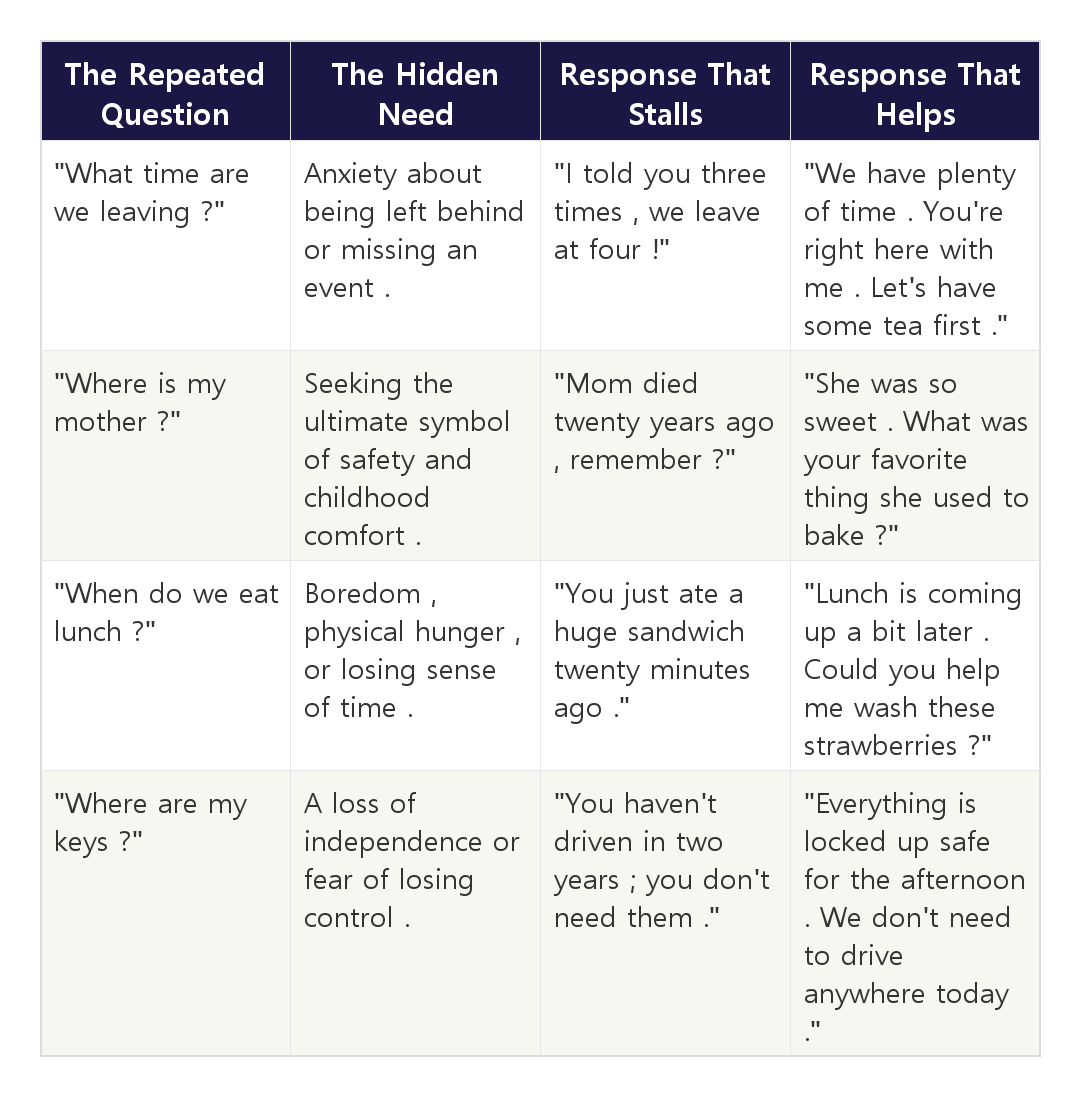
Four common loops and better ways to respond
Here is how you can reframe some of the most frequent repetitive questions you might encounter at home.

Protect your own calm before you respond
You cannot pour patience from an empty cup. Hearing the same sentence over and over triggers a genuine sensory overload in the human brain.
When you feel your throat tightening or your voice rising, it is completely acceptable to step out of the room for thirty seconds. Take three slow breaths, unclench your shoulders, and remind yourself that the disease is doing the talking.
Caregiving is an endurance marathon, not a sprint. Preserving your own emotional baseline is what allows you to show up with grace tomorrow.
FAQ
Q. Why does the repetitive questioning get so much worse in the evening?
A. This is commonly linked to sundowning, where mental fatigue, lower lighting, and shadows increase baseline anxiety. As cognitive reserves drop at the end of the day, emotional coping mechanisms fall with them.
Q. Can signs or sticky notes help reduce the questions?
A. For some people in the early stages, a clear whiteboard showing the date and the next scheduled meal helps. However, as dementia progresses, reading comprehension declines, and notes may begin to cause more confusion than comfort.
Q. Is it wrong to use “therapeutic untruths” when they ask for deceased relatives?
A. Reminding someone repeatedly that their deceased spouse or parent is gone forces them to re-experience raw grief anew every single day. Validating their love and steering the conversation toward fond memories is an act of genuine compassion, not deception.
Q. When should I bring repetitive behavior up with a healthcare provider?
A. If the repetition spikes suddenly overnight or is accompanied by acute distress, disorientation, or agitation, notify their doctor promptly to rule out underlying infections such as a UTI. Repetitive questions stem from short-term memory deficits coupled with underlying emotional needs like anxiety or boredom. Correcting a person with dementia or reminding them they already asked creates defensiveness and escalates the behavior. Brief, soothing answers followed by a gentle redirection to an engaging activity produce the best results for both of you.
Helpful links — Sister Unice’s picks
The best places to go deeper, hand-picked:
- Alzheimer’s Association: Repetition Causes and Response Guide — The nation’s leading dementia advocacy non-profit provides concrete, expert-vetted strategies for de-escalating repetitive questioning by addressing the emotional need beneath it.
- National Institute on Aging: Communicating With Someone Who Has Alzheimer’s Disease — The official federal health authority on aging outlines practical, research-backed communication techniques and calming responses for home caregivers.
- Family Caregiver Alliance: Caregiver’s Guide to Understanding Dementia Behaviors — A trusted national caregiver support organization delivering clinical insights into perseveration, verbal loops, and gentle redirection.
- Family Caregiver Alliance: Dementia, Caregiving, and Controlling Frustration — Specialized caregiver guidance offering physiological and psychological tools to reset your patience when repetitive behavior becomes overwhelming.
Links go to third-party booking/shopping sites. I only list places and products with genuinely strong reviews.
Unice recommends this guide because it gently helps you respond to the emotion and insecurity fueling repetitive questions rather than getting trapped in exhausting logic loops.
Not a paid placement or affiliate link — just a resource Unice trusts.
Leave a Reply